Evolution of Rotation from Early-type, Binary, Oscillating stars
The study of stellar oscillations has allowed significant progress in the modelling of low-mass stars over the last few decades but has left out intermediate- and high-mass stars (above 1.5 solar masses). These stars are of utmost importance as they drive the chemical enrichment of the Galaxy and are the progenitors of supernovae, neutron stars and black holes. To extend asteroseismology’s probing power towards higher masses, the best candidates are the abundant delta Scuti pulsators. However, the rapid rotation they harbour (>100 km/s at the equator) makes the interpretation of observations and the modelling of these stars difficult and requires dedicated 1D and 2D stellar models and oscillation calculations. It is unclear whether this rotation can emerge from formation processes or binary interactions, while the inner rotation of stars is also more homogeneous than expected. Understanding the origin and redistribution of angular momentum is the final goal of the EREBOS project. The main steps include defining a set of benchmark stars, that associate asteroseismic, spectroscopic, binary orbit and/or interferometric measurements to test the various state-of-the-art modelling tools available. Assessing the various codes' respective limitations, using the most relevant ones derive the most accurate parameters for rapid rotators to date, and building extensive grids of models are the key steps of the project. This will pave the way to ensemble asteroseismology of intermediate-mass pulsators, and open a window on the evolution of rotation rates and the internal angular momentum redistribution across the stellar lifetimes. EREBOS is a project funded by the Junta de Andalucía through their talent attraction program Emergía, grant EMEC_2023_00533.
Here are the excellent scientists that belong to the EREBOS team!
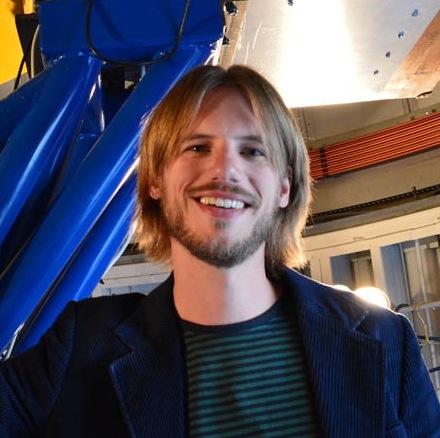
Giovanni M. MirouhEmergía fellow at the University of Granada and PI of the project. An expert of 1D and 2D stellar models and associated oscillations in presence of rotation. |

![]() |
![]() |
Antonio García HernándezHe is an associate professor at the University of Granada. Covering delta Scuti stars from observations to models, he is the author of the first observational discovery of regular patterns in frequency spectra of these stars. |
Javier Pascual GranadoA researcher at IAA-CSIC in Granda, he is an expert of lightcurve analysis and gap-filling procedures whose input will be key to extract accurate oscillation frequencies from eclipsing binary observations. |
![]() |
![]() |
Juan Carlos SuárezA professor at the University of Granada, he is an expert in intermediate-mass pulsators and a member of the PLATO board, he developed the FILOU oscillation code. |
Louis ManchonA research fellow at LIRA Observatoire de Paris, he co-develops and maintains the CESTAM2D code that is crucial to the project. |

![]() |
![]() |
Daniel R. ReeseAn astronomer at LIRA Observatoire de Paris (France), he is the main developer of the TOP 2D oscillation code. His input will be key to compute oscillations and address possible scalability issues. |
Patrick GaulmeThe project started with the ever-so-helpful presence of Patrick, staff scientist at Thuringian State Observatory (Germany). After a year of relentless fighting against illness, Patrick passed away on July 14, 2025, a few days before his 47th birthday. He leaves behind a wife and four children, and many friends who will miss him dearly. Che la terra ti sia finalmente lieve Badrizio. |
![]() |
The project started in May 2025, we do not have publications to boast about yet!
Snail mail: Edificio Mecenas, despacho 16 calle Prof. Adolfo Rancaño s/n 18071 Granada - Spain Email: gmm at ugr dot es